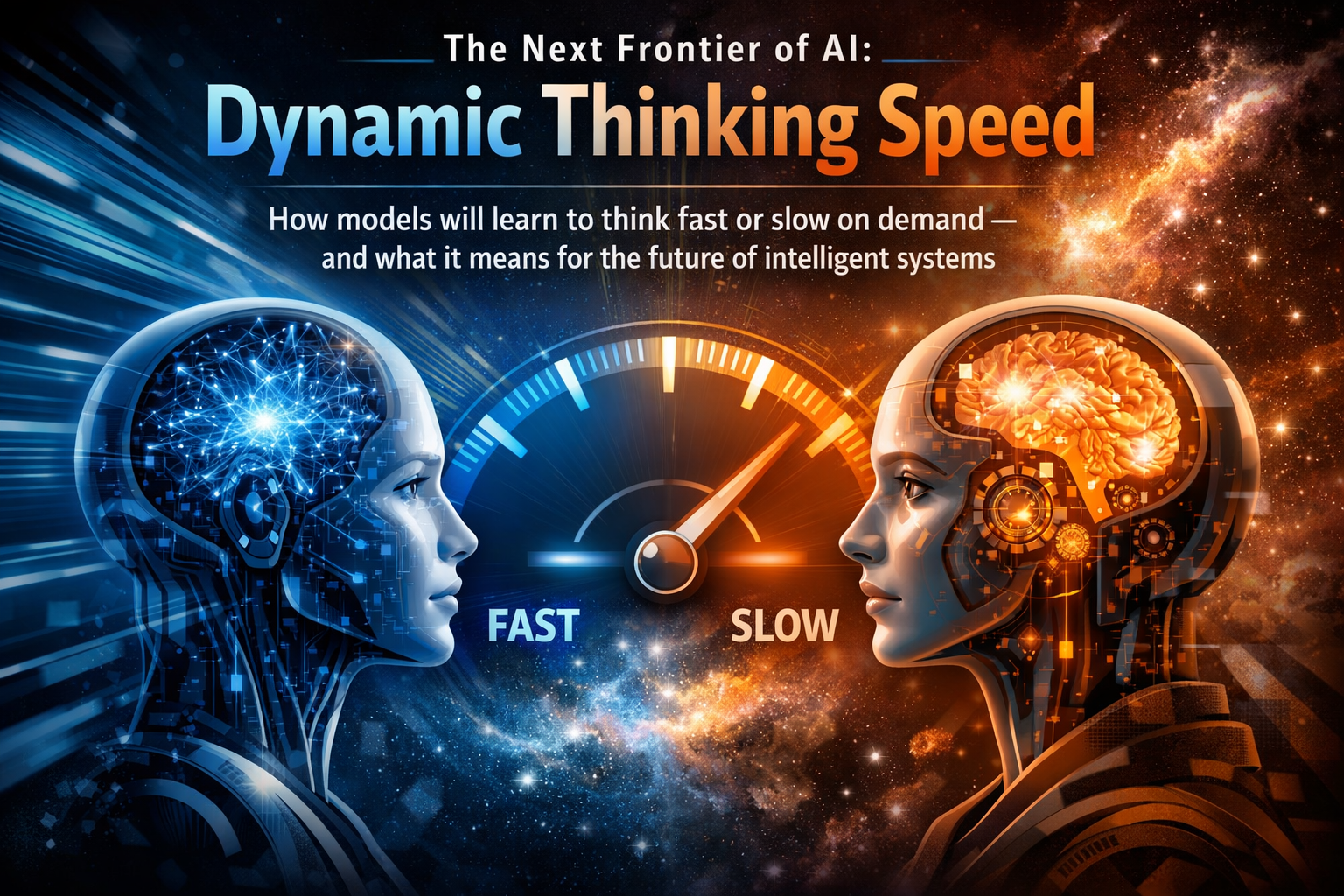
How models will learn to think fast or slow on demand — and what it means for the future of intelligent systems
Introduction
When you’re driving and a red light flashes, you react instantly.
When you’re making an investment decision, you stop, analyze, and deliberate.
Humans instinctively shift between two modes of thought: System 1 — fast, intuitive thinking, and System 2 — slow, analytical reasoning.
Artificial intelligence, until recently, didn’t have that choice. Large language models (LLMs) like GPT-4 or Claude 3 reason at a fixed pace: they generate long, step-by-step explanations even for trivial tasks, wasting tokens, time, and energy. But what if AI could dynamically adjust its speed of thought — zipping through easy problems and slowing down only when deeper reasoning is needed?
That’s the idea behind a wave of new research into controlling reasoning speed. It’s an emerging paradigm that could make AI not just smarter, but more efficient, interpretable, and cost-effective.
Why Thinking Speed Matters
1. The Efficiency–Accuracy Tradeoff
Current LLMs treat every question as equally hard. Whether it’s “What’s 5 + 7?” or “Prove Fermat’s Last Theorem,” they often deploy the same chain-of-thought machinery. This leads to overthinking on easy tasks and underthinking on hard ones.
Dynamic thinking speed offers a new lever: allocate more compute to complex reasoning while speeding through straightforward cases.
In experiments, researchers have already shown that models can improve accuracy while using fewer tokens — essentially, thinking smarter, not just harder.
2. Interpretability and User Control
Imagine asking your AI assistant,
“Give me the quick answer.”
or
“Take your time — walk me through the reasoning.”
Controllable thinking speed gives users the ability to toggle between fast summaries and deep analyses. This makes AI more interactive and human-like — intuitive when needed, methodical when it counts.
3. Cost, Scalability, and Energy
Inference costs grow linearly with token usage. If a model can finish simple queries with fewer reasoning steps, the cumulative savings across millions of calls are enormous. Adaptive reasoning could become a cornerstone of cost-efficient AI infrastructure — especially as enterprises deploy LLMs at scale.
The Science of Dynamic Thinking
Several research teams are exploring how to teach AI when — and how — to shift between fast and slow reasoning. Here’s a look at the leading approaches.
| Paper / Approach | Core Idea | Metrics Improved | Key Highlights |
| Controlling Thinking Speed in Reasoning Models (Lin et al., 2025) | Finds a steering vector in a model’s internal representations that moves it between fast and slow reasoning. Combines this with a real-time difficulty estimator to adapt reasoning speed mid-inference. | +1.3% accuracy, −8.6% token usage | The first “plug-and-play” test-time method for thinking control — no retraining needed. |
| AlphaOne: Reasoning Models Thinking Slow and Fast at Test Time (Zhang et al., 2025) | Introduces a unified α₁ framework that schedules transitions between slow and fast reasoning, using “wait” tokens to control reflection moments. | Accuracy, reasoning token count | Enables continuous scaling of reasoning effort with controllable density of slow-thinking segments. |
| Dualformer: Controllable Fast and Slow Thinking (Su et al., 2024) | Trains models with randomized reasoning traces so they can output either concise (fast) or full (slow) reasoning at will. | Success rate, reasoning steps | Demonstrates 45% fewer steps in slow mode while outperforming baseline reasoning quality. |
| Thinking Intervention (Wu et al., 2025) | Modifies reasoning traces during generation to guide internal logic flow. | Accuracy, safety, alignment | Improves instruction-following by up to 6.7%, hierarchical reasoning by 15%, and enhances refusal accuracy on unsafe prompts by 40%. |
| Adaptive Overclocking (Jiang et al., 2025) | Uses token-level uncertainty and semantic divergence to decide when to accelerate or slow down reasoning. | Accuracy-latency tradeoff | Reduces overthinking on easy inputs while preserving deep reasoning on hard ones. |
| Overclocking LLM Reasoning (Roy Eisen et al., 2025) | Identifies a “thinking progress vector” in hidden states and manipulates it to shorten reasoning paths. | Token count, correctness | Achieves up to 6× fewer tokens while maintaining correctness on logic tasks. |
The Metrics That Matter
✅ Accuracy (Pass@1, task success)
The gold standard: does the model still get the answer right?
Dynamic reasoning aims to improve or maintain accuracy even when reasoning speed varies.
⚙️ Token Usage / Compute Efficiency
Every token generated is compute spent. A 10% reduction in token usage at scale can save millions in cloud costs — while also reducing environmental footprint.
⏱ Latency
Dynamic thinking cuts response times for simple inputs — critical for real-time systems, chatbots, and mobile applications.
📈 Tradeoff Curves (Accuracy vs Compute)
Researchers visualize progress as a Pareto frontier: better accuracy for the same compute budget. Methods like Lin et al.’s steering approach and AlphaOne’s α₁ scheduling clearly push this frontier outward.
🤔 Overthinking / Underthinking Rate
A measure of how often the model wastes compute on trivial tasks or fails on complex ones. Adaptive methods aim to minimize both.
🧩 Alignment and Robustness
Techniques like Thinking Intervention show that manipulating reasoning can also improve safety — models become more consistent and cautious in sensitive contexts.
Why This Matters for the Future of LLMs
1. Smarter Resource Allocation
Instead of scaling model size endlessly, we can scale how intelligently compute is used. Future AI systems might continuously self-regulate — thinking deeply only when necessary, conserving power the rest of the time.
2. Personalized Intelligence
Imagine adjustable “thinking profiles”:
- Fast mode for quick chats.
- Slow mode for deep analysis or creative writing.
- Auto mode that decides for itself.
Dynamic thinking speed could become a user-facing feature — an “AI cognition dial.”
3. More Human-Like Cognition
Human reasoning isn’t linear; it flexes. Models that mirror this adaptability will feel more natural and trustworthy, knowing when to pause and reflect rather than producing mechanical verbosity.
4. Safer, More Transparent AI
When reasoning depth is controllable, audits and verification become easier. Regulators or developers could require “slow-mode reasoning traces” for high-stakes domains like medicine, law, or finance.
5. Energy-Efficient Intelligence
Dynamic speed control can lower global AI energy consumption — a growing sustainability concern. Thinking faster on easy problems is not just good engineering; it’s good ethics.
Challenges and Open Questions
- Detection: How can models reliably estimate problem difficulty in real time?
- Stability: How to ensure steering vectors or α-controls don’t destabilize reasoning or hallucinate?
- Granularity: Should speed adjustments happen per token, per reasoning step, or per question?
- Benchmarking: The field still lacks standardized tests for “adaptive reasoning performance.”
- Interpretability: As we add more control layers, will reasoning become more or less explainable?
These challenges represent opportunities — fertile ground for new frameworks, metrics, and architectures that bring cognitive flexibility to machines.
Conclusion
AI is entering an age of cognitive elasticity — the ability to flex between speed and depth of thought.
Instead of always “thinking longer” to get better answers, future models will learn to think smarter: fast when they can, slow when they must.
Dynamic thinking speed won’t just make AI faster or cheaper; it will make it more human.
In the coming years, this shift may define a new generation of reasoning models — efficient, adaptive, and aware of their own thought processes.
Key Takeaway
The next leap in AI reasoning isn’t about bigger models — it’s about teaching them when to pause, and when to sprint.