You Don’t Invent Software — You Extract It From Operations
For years, software startups were built from scratch: a founder with an idea, a product team, venture capital, and a race to find product-market fit.
But something fundamental has changed.
Today, the most powerful software companies don’t have to come from Silicon Valley. They may begin in medical clinics, fitness centers, consulting firms, and staffing companies.
Because many service businesses already contains a billion dollar idea for a software company inside it.
The only question is whether you see it.
The Hidden Software Inside Your Business
If you run a service business, you already have:
- Documented (or undocumented) SOPs
- Repeatable workflows
- Staff making high-value judgment calls
- A customer base that pays for outcomes
- Data flowing through your operations every day
That’s not just a service business.
That’s the raw material of a software factory.
Let’s break it down.
1. SOPs = Your Product Backlog
Your standard operating procedures are not “admin documents.”
They are features waiting to be extracted.
Every checklist…
Every intake form…
Every escalation path…
Every onboarding sequence…
That’s product logic.
In software terms, your SOP library is a product backlog.
Medical Clinics
A clinic already has:
- Patient intake workflows
- Insurance verification steps
- Triage decision trees
- Follow-up protocols
- Preventative care reminders
These are rule systems. That means they can be codified.
Instead of hiring more front-desk staff, a clinic can build:
- AI intake assistants
- Automated prior authorization workflows
- Predictive scheduling optimization tools
The operational playbook becomes the platform.
Fitness Centers
A gym already knows:
- How to onboard a new member
- How to design a transformation plan
- How to schedule classes efficiently
- How to trigger re-engagement when attendance drops
That’s not “just management.”
That’s productized behavior change software.
The SOP for:
“If a member misses 3 sessions, send X message and offer Y incentive.”
That becomes:
- Automated retention engines
- AI coaching nudges
- Personalized habit tracking systems
Your playbook becomes a subscription software layer.
Consultants
Consulting firms are walking knowledge engines.
They:
- Diagnose business problems
- Apply frameworks
- Generate recommendations
- Implement structured transformations
That’s algorithmic thinking with a human interface.
The difference between consulting and SaaS is often:
- Packaging
- Repeatability
- Automation
Your diagnostic frameworks can become:
- AI assessment tools
- Decision engines
- Scorecards
- Industry-specific dashboards
You don’t invent new software.
You extract your intellectual capital and encode it.
Staffing Companies
Staffing firms already operate on structured workflows:
- Candidate sourcing pipelines
- Resume screening criteria
- Interview scoring models
- Job-fit heuristics
- Placement follow-ups
That’s matching logic.
Which means it can be:
- Automated
- Enhanced with AI
- Productized for clients
Instead of manually screening resumes, you build:
- AI candidate fit scoring engines
- Automated compliance tracking systems
- Workforce analytics dashboards
The recruiter’s judgment becomes defensible IP.
2. Judgment = Defensible Intellectual Property
The real asset in a service business is not labor.
It’s judgment.
The doctor’s clinical pattern recognition.
The trainer’s ability to motivate clients.
The consultant’s structured thinking.
The recruiter’s intuition about candidate fit.
That judgment is not random.
It follows patterns.
And patterns can be modeled.
When you encode your decision logic into software:
- You scale expertise without hiring more experts.
- You create intellectual property competitors can’t copy.
- You reduce variability.
- You increase margin.
This is how service companies move from:
Linear revenue growth
to
Exponential valuation growth.
3. Repetition = Automation Opportunity
Look at your team’s calendars.
What do they repeat every week?
- Intake calls
- Status updates
- Progress reviews
- Scheduling adjustments
- Reporting
- Follow-ups
Repetition is not a burden.
It’s a signal.
Every repeated workflow is a candidate for:
- Automation
- AI agents
- Decision trees
- Self-service portals
Medical Clinics
- Repeated lab result reviews → AI triage alerts
- Repeated appointment scheduling → smart scheduling engines
- Repeated patient education → AI-powered health guidance
Fitness Centers
- Repeated form checks → computer vision analysis
- Repeated progress tracking → automated performance dashboards
- Repeated nutrition reviews → AI macro coaching
Consultants
- Repeated discovery interviews → AI diagnostic surveys
- Repeated strategy decks → automated insight reports
- Repeated KPI tracking → live performance dashboards
Staffing Companies
- Repeated screening calls → AI pre-screen agents
- Repeated compliance paperwork → automated workflows
- Repeated client reporting → predictive workforce dashboards
Repetition is not overhead.
It’s product potential.
4. Your Market Already Exists
Startups struggle with product-market fit.
Service businesses already have it.
You already have:
- Paying customers
- Industry credibility
- Distribution channels
- Feedback loops
- Data sets
That’s an unfair advantage.
When you extract software from operations, you don’t have to guess what people want.
You know.
Because they already pay for it.
You are not inventing a new problem.
You are encoding a proven solution.
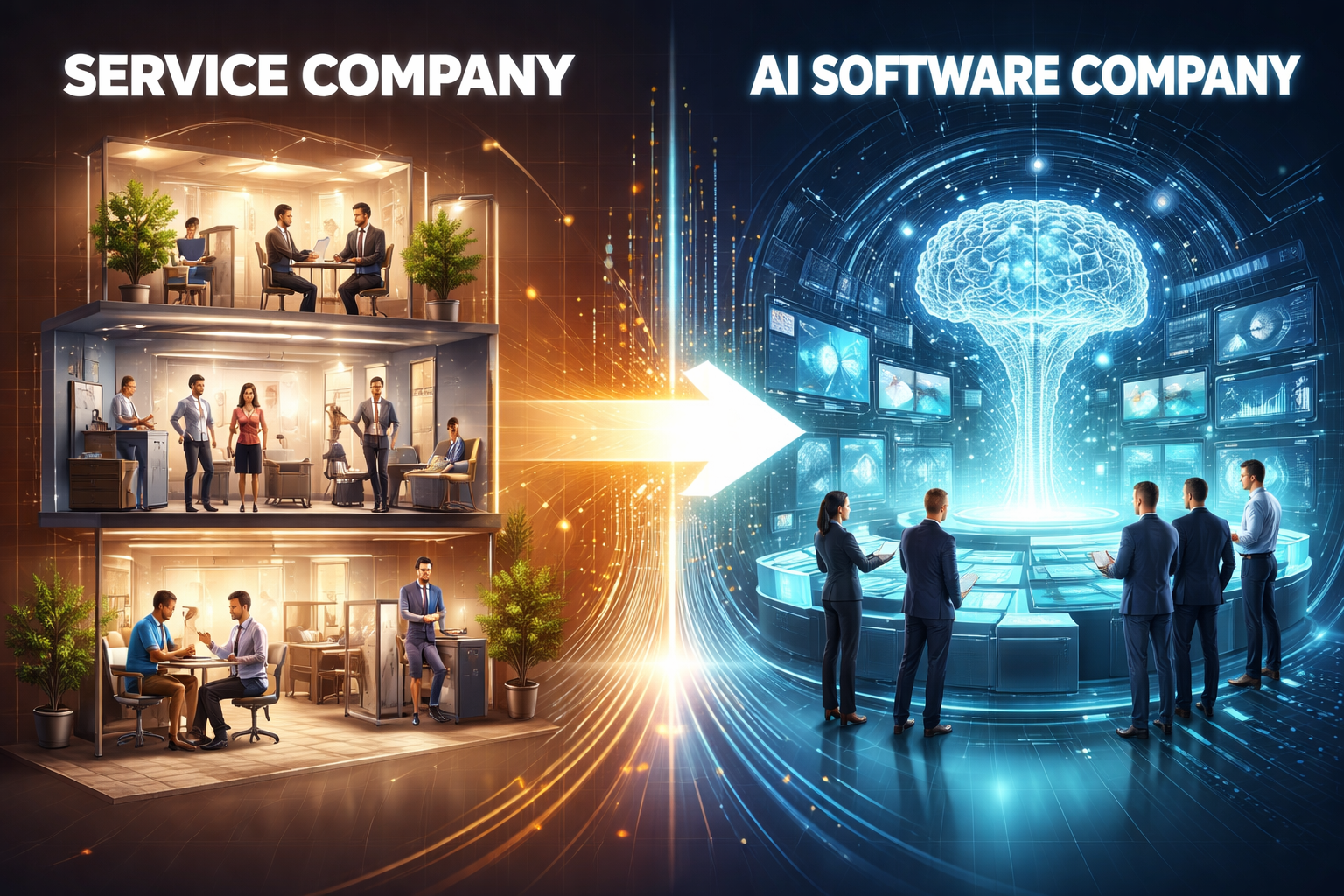
The Transformation: From Service Company to Software Factory
Here’s the shift:
| Traditional Service Model | Software-Embedded Model |
|---|---|
| Revenue tied to headcount | Revenue tied to systems |
| Manual variability | Standardized intelligence |
| Margin constrained by labor | Margin expanded by automation |
| Growth = hiring | Growth = deployment |
When you embed software into operations:
- Margins expand
- Valuations increase
- Scalability improves
- Customer experience becomes consistent
And eventually, you stop just delivering services.
You deliver systems.
The Extraction Process
So how does this happen?
It starts with one discipline:
Operational mapping.
- Document workflows
- Identify repeated decisions
- Map judgment patterns
- Prioritize high-friction areas
- Extract logic into software modules
You don’t begin with “What app should we build?”
You begin with:
“What do we already do that works every single time?”
Then you encode that.
Why This Matters Now
AI agents change the economics of software development.
You no longer need a 50-person engineering team to build internal tools.
You need:
- Process clarity
- Structured thinking
- Iterative deployment
- Customer feedback loops
The barrier is no longer technical.
It’s strategic.
The companies that win won’t be the ones that build random apps.
They will be the ones that turn their operations into platforms.
A New Class of Company
The future may not belong to pure SaaS startups.
It may belong to:
- Clinics that become health intelligence platforms
- Gyms that become behavior-change engines
- Consultants that become decision software companies
- Staffing firms that become workforce data platforms
These organizations don’t abandon service.
They enhance it.
They move from:
Service Provider
to
Service + Software Operator
to
Industry Platform.
The Key Line
You don’t invent software — you extract it from operations.
Your SOPs are features.
Your judgment is intellectual property.
Your repetition is automation opportunity.
Your market already trusts you.
Inside your service business is a scalable system waiting to be built.
The question is:
Will you keep selling time…
Or will you start extracting software?